 AutoTaxCalculator
How much does it cost to switch a car title? The title fee itself runs from $4 in Arizona to $214.50 in Wisconsin, and most states charge $15 to $75. But a title transfer after a sale almost always comes with more: sales or use tax on the price (usually the biggest cost by far), registration or a plate transfer fee, a lien recording fee if the car is financed, and late penalties if you miss the deadline. For a typical used car, the title fee is a small fraction of the total.
"How much is title?" is one of the most common questions at the DMV counter, and the honest answer has two parts. The certificate of title fee is a fixed charge for issuing a new title document in your name, and it's the same whether the car is worth $3,000 or $80,000. Everything else depends on the transaction: a purchase brings tax, a loan brings a lien fee, a new plate brings a plate fee, and a late visit brings penalties.
This guide lists the title fee in every state where we've verified it from the state DMV or revenue department while building our state calculators, then walks through the extra charges, family transfers, duplicates and corrections, and worked examples of the full cost of switching a title.
Title transfer fees by state
These are the fees for a standard certificate of title on a passenger car. Where a state adds a lien fee, a speed or expedited option, or a county fee, it's noted.
| State | Title fee | Notes |
|---|---|---|
| Arizona | $4 | Certificate of title |
| Kentucky | $9 | $25 speed title; $22 lien |
| Mississippi | $9 | Paid at the county tax collector |
| Arkansas | $10 | One-time |
| South Dakota | $10 | $10 lien notation |
| Oklahoma | $11 | Plus excise tax on a sale |
| Montana | $12 | Light vehicle; $7 from July 1, 2028 |
| Idaho | $14 | Plus your county's title admin fee |
| Tennessee | $14 | Knox County example; $11 lien |
| Alabama | $15 | Plus agent commissions of up to $3 |
| Alaska | $15 | $15 lien recording |
| California | $15 | Transfer fee; $15 penalty if late; $28 title-only |
| Indiana | $15 | New owners |
| Michigan | $15 | +$1 lien, +$5 expedited |
| Virginia | $15 | Original title |
| West Virginia | $15 | $10 lien |
| Wyoming | $15 | |
| Missouri | $17.50 | $8.50 title + $9 processing |
| Georgia | $18 | Plus TAVT on a purchase |
| Washington | $24.50 | $6.50 filing + $18 service |
| Connecticut | $25 | |
| Nevada | $28.25 | First Nevada title |
| Texas | $28 or $33 | $33 in emissions-program counties |
| Iowa | $30 | Same fee for all titles |
| Washington DC | $30 | $20 per lien |
| Delaware | $35 | $55 with a lien |
| Vermont | $42 | $14 security interest |
| New York | $50 | New registrations |
| Rhode Island | $53.50 | Same for duplicate or salvage title |
| New Jersey | $60 | $85 with a lien |
| North Carolina | $66.75 | Certificate of title |
| Louisiana | $68.50 | Plus $8 handling |
| Pennsylvania | $72 | $36 per lien; agent fees extra |
| Massachusetts | $75 | $25 duplicate |
| Florida | $75.25–$85.25 | $85.25 for a car from another state |
| Oregon | $101–$192 | Set by MPG: $101 (0–19), $106 (20–39), $116 (40+), $192 electric |
| Wisconsin | $214.50 | Original title or transfer |
We haven't yet verified the title fee for Colorado, Hawaii, Illinois, Kansas, Maine, Maryland, Minnesota, Nebraska, New Hampshire, New Mexico, North Dakota, Ohio, South Carolina or Utah, so they're left out rather than guessed. Check your state DMV for those.
Two states stand out. Oregon is the only one we've found that sets the title fee by fuel economy, so an electric car's title costs nearly twice a gas car's. Wisconsin's $214.50 is by far the highest flat title fee, though it waives the fee for transfers to a surviving spouse, registered domestic partner or qualifying family member.
Why title fees vary so much
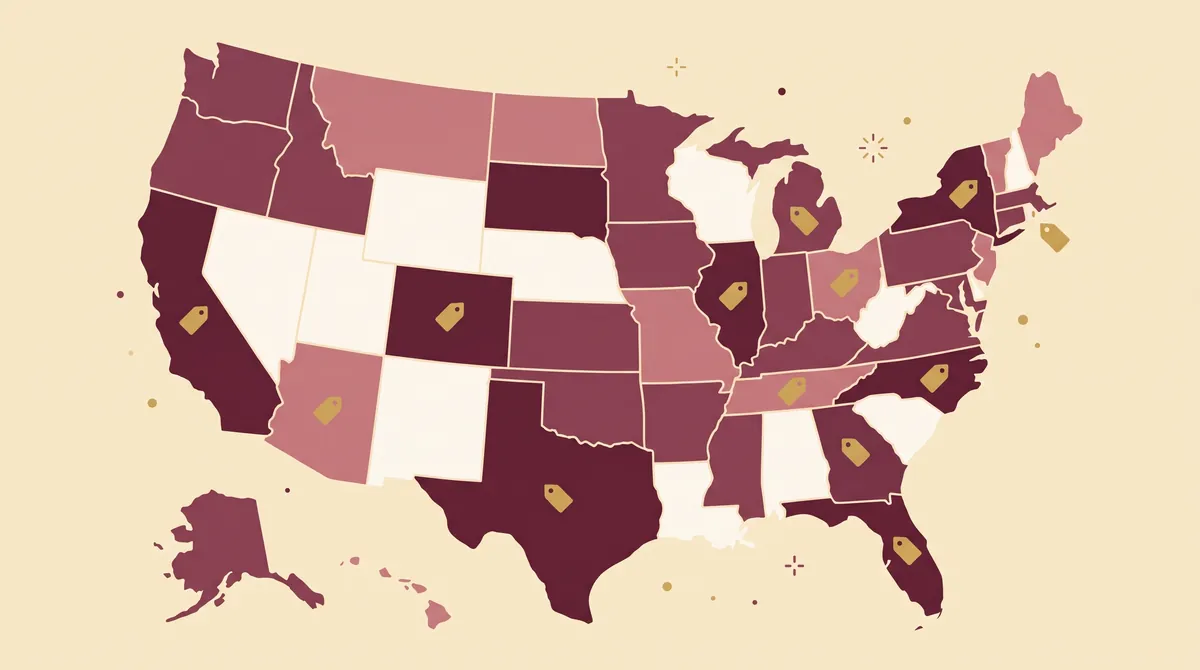
A certificate of title does the same job everywhere: it records who owns the car and whether a lender has a claim on it. So why does the same piece of paper cost $4 in Arizona and $214.50 in Wisconsin?
Mostly because states use the title fee to fund different things. Some keep it close to the cost of processing. Others use it as a revenue source for roads or the DMV itself. A few states have built policy into it: Oregon ties the title fee to fuel economy, so a car rated 0 to 19 MPG pays $101, 20 to 39 MPG $106, 40 MPG or more $116, and an all-electric car $192. The higher fees for efficient cars exist because they pay little or no gas tax.
The other source of variation is who handles the paperwork. In Idaho, each county sets its own title admin fee on top of the $14 state fee. In Pennsylvania, you complete transfers through an authorized agent, who charges a service fee on top of the $72 state fee. In Alabama, agents can add commissions of up to $3. So two people switching a title in the same state can pay slightly different totals depending on where they go.
None of that changes the basic answer to how much does it cost to switch a car title: in most states, the fee is a flat amount you can look up in advance, and it's small next to the tax.
Title vs registration: what you're actually paying for
People often use "title" and "registration" interchangeably, but they're separate records with separate fees.
- The title is proof of ownership. You get it once when the car becomes yours, and again only when ownership changes, you need a duplicate, or details need correcting.
- The registration is permission to drive the car on public roads. It's renewed every year or two, comes with plates and stickers, and is where most yearly fees and value-based taxes are charged.
You can have one without the other. California, for example, offers a title-only application for $28 and a planned nonoperation filing for a car that won't be driven, so a car can be titled in your name without active registration. In most states, though, buying a car and driving it means paying for both on the same visit.
That's why "how much is title" and "how much is registration" have such different answers. The title is usually a one-time, flat charge. The registration repeats, and in many states depends on the car's weight, age or value. Our registration fee calculator covers that side.
Liens and getting a clear title
If a car is financed, the lender's interest is recorded on the title as a lien. That has two effects on the cost and process of a transfer.
When you buy with a loan, recording the lien adds a fee: $1 in Michigan, $10 in South Dakota and West Virginia, $11 in Tennessee (Knox County), $14 for a Vermont security interest, $15 in Alaska, $20 in Delaware and DC, $22 in Kentucky, $25 more in New Jersey and $36 in Pennsylvania.
When you sell a financed car, the lien has to be released before the buyer can get a clean title. Usually that means paying off the loan and getting a lien release from the lender. Buying a car with an unreleased lien is one of the most common title problems, so ask to see the title, or the lender's payoff letter, before paying a private seller.
A lien release itself usually doesn't trigger tax. Texas, for example, says a lien release doesn't trigger motor vehicle tax.
Dealer vs private sale
Buying from a dealer is the easy route for title paperwork. The dealer usually prepares the title application, collects the title fee, tax and registration with the sale, and submits everything for you. You'll see the fees on the buyer's order, and the new title or registration arrives later.
A private sale puts the work on the buyer. You take the signed title and bill of sale to the DMV, county office or agent yourself, pay the tax there, and apply for the new title. Some states add steps: Pennsylvania requires buyer and seller to complete the transfer at an authorized agent, and New York uses Form DTF-802 for the price and any exemption. Missing a form can mean a second trip, and in states with deadlines, a second trip can mean a penalty.
The title fee is usually the same either way. What changes is who handles it, and in some states the tax: private sales often get no trade-in credit and may be taxed on book value.
Title problems to check before you pay
- The seller's name isn't on the title. If the person selling isn't the owner shown, the transfer can't be completed normally.
- There's an open lien. Ask for proof the loan is paid off, or arrange the payoff at the time of sale.
- The title is branded. Salvage, rebuilt or similar brands affect value, insurance and resale.
- The title is missing. The seller should get a duplicate first; it's their fee to pay, not yours.
- The odometer reading doesn't match the car or its service records.
Each of these can turn a $15 title transfer into weeks of paperwork, or into a car you can't title at all.
How much is title transfer, all in?
When people ask "how much is title" at the DMV, they usually mean the whole bill. Here's what typically comes with a title transfer after a sale:
- Sales or use tax. The big one. On a $15,000 used car it's often $600 to $1,300, depending on the state. See our state-by-state tax comparison.
- The title fee from the table above.
- A lien fee if you financed: $1 in Michigan, $10 in South Dakota and West Virginia, $15 in Alaska, $20 in Delaware and DC, $22 in Kentucky, $25 more in New Jersey, $36 in Pennsylvania.
- Registration or a plate transfer. Either a new registration or the fee to move your plates: $3 in Louisiana, $4.50 in New Jersey, $10 to $15 in Michigan, $11 in Pennsylvania, $17.50 in Tennessee, $30 in Oregon.
- Local or agent fees. Idaho counties add a title admin fee; Pennsylvania agents charge their own service fee; Alabama agents add up to $3.
- Late penalties if you're past the deadline.
So how much does it cost to switch a car title when you buy a used car? Usually several hundred dollars to over a thousand, almost all of it tax. When no sale is involved, such as adding a spouse or moving a car between family members, the total can be just the title fee.
Budgeting the whole transfer
Before you go to the DMV, it helps to add up the full amount so there are no surprises at the counter. Here's a simple way to estimate how much it will cost to switch a car title after a purchase:
- Tax. Multiply the taxable price by your state's rate. Remember that some states tax book value on private sales, and some don't give trade-in credit on them. Your state's calculator page does this step for you.
- Title fee. Use the table above, plus any county or agent fee.
- Lien fee, if you're financing.
- Registration or plate transfer. A new registration if you need plates, or the plate transfer fee if you're moving plates from a car you sold.
- One-time extras. Florida's $225 initial registration fee if you don't have a Florida plate to transfer, a VIN inspection for a car from another state ($4 in Oklahoma, $10 in Wyoming), or an emissions inspection where required.
- A buffer for penalties if you're already past the deadline.
On most used-car purchases, step 1 is by far the largest part of the total. If you're trying to answer how much does it cost to switch a car title with no sale involved, such as moving a car between spouses, skip step 1 and check whether your state waives the title fee too.
Title fees and your tax return
A title fee isn't a deductible tax on your federal return. It's a fee for a government service, like a driver's license fee. But it isn't wasted for tax purposes either: IRS Publication 551 lists recording fees among the costs that go into the basis of property you buy, so the title fee becomes part of your car's cost basis along with the sales tax. That matters if you later sell the car for a gain, or use it in a business and depreciate it. Our guide to vehicle basis on taxes explains how.
The sales tax paid at the same visit is different. If you itemize and choose sales tax over state income tax, it can be deducted on Schedule A; see is car sales tax deductible?
Late title transfer penalties
Every state sets a deadline to transfer the title after a sale, and many charge a penalty when you miss it:
| State | Late title penalty |
|---|---|
| Missouri | $25 for days 31–60, $50 for 61–90, +$25 per further 30 days, up to $200 |
| California | $15 penalty on a late transfer |
| Florida | $20 late title fee |
| Oregon | $25 if more than 30 days after buying an Oregon-titled vehicle |
| Ohio | $5 late fee |
| New Mexico | 50% add-on penalty after 90 days |
| Michigan | $15 if not transferred within 15 days |
Late tax penalties are often bigger than late title penalties: Texas adds 5% of the motor vehicle tax if you're 1–30 days late and 10% after that. Our guide to late fees by state covers more.
Family transfers, gifts and inheritances
When a car moves within a family, the title fee usually still applies but the tax often doesn't. A few examples from our state pages:
- Wisconsin: no title fee for transfers to a surviving spouse, registered domestic partner or qualifying family member.
- Illinois: a $15 private-party tax for qualifying family transfers, instead of the price-based tax.
- Georgia: a reduced 0.5% TAVT on qualifying family transfers of a Georgia-titled car.
- California, Massachusetts, Connecticut, Idaho, Minnesota, Oklahoma, South Dakota, Tennessee, New Mexico: family transfers or genuine gifts can be exempt from sales or use tax, usually with a form or affidavit.
- Florida: transfers to an immediate family member don't trigger the $225 initial registration fee.
For an inherited car, the estate or heirs usually need the death certificate and court or affidavit paperwork the state requires. Fees vary, and some states, like Illinois with its $15 estate transfer, treat it as a reduced-tax transfer.
Duplicate titles, corrections and name changes
Not every title transaction is a sale. Some common ones and what they cost:
- Duplicate or replacement title: $25 in Massachusetts, $28 in California, $53.50 in Rhode Island, $75.25 in Florida (transfer or duplicate).
- Faster processing: Kentucky's speed title is $25; Michigan's expedited title adds $5; Florida's fast title adds $10.
- Corrections: Louisiana charges $68.50 for a title correction; Massachusetts $25 to amend a title.
- Adding or removing a name: in Texas, adding a name or another ownership change means a new title application at the regular $28 or $33 fee. Neither a married name change nor releasing a lien brings any motor vehicle tax with it.
Titling a car when you move to a new state
New residents have to switch their out-of-state title to the new state, usually within a set period. The title fee is often the same as for any transfer, with a few differences: Florida charges $85.25 for a title on a car coming from another state, Nevada charges $28.25 for a first Nevada title, and North Carolina new residents pay the $66.75 title fee plus their county's plate fee. Tax is usually much lower than on a purchase, or zero, if you owned the car before moving. See our moving section for each state's new-resident tax.
How to switch a car title, step by step
- Seller signs the title over in the assignment section, with the price and odometer reading where required. If there's a loan, the lien has to be released first.
- Both sign a bill of sale if your state requires one or the title doesn't show the price.
- Buyer gets insurance on the car before driving it.
- Buyer applies for the new title at the DMV, county office or licensed agent, within the state's deadline.
- Pay the title fee, tax and registration, plus a lien fee if financed.
- Keep copies of everything until the new title arrives.
Worked examples
Private $15,000 used car in New Jersey, financed
Sales tax: $15,000 × 6.625% = $993.75. Title with a lien: $85. Plus registration. Title-related total before registration: $1,078.75.
Private $12,000 car in Missouri, titled on day 45
Title fees: $17.50. Late title penalty for days 31–60: $25. Plus state and local sales tax on $12,000 and registration.
Transfer to a surviving spouse in Wisconsin
No title fee for this kind of family transfer, and no sale price to tax. Just registration if needed.
Moving to Florida with a car you own
Title from another state: $85.25, plus the $225 initial registration fee if you don't have a Florida plate to transfer, plus the yearly registration.
Private used car in Lubbock County, Texas, priced below its value
Our Texas page works through this one: a used car bought for $9,000 with a standard presumptive value of $14,000. Texas taxes 80% of SPV, $11,200, because it's higher than the price: $700 in tax. Add the $28 title, $51.75 registration, $10 local fee and $7.50 and $4.75 in other fees: $802 in total, of which the title is $28.
A new electric car in Oregon
A new car from an Oregon dealer pays the 0.5% privilege tax. The title fee for an all-electric car is $192, the highest MPG tier, plus registration.
Frequently asked questions
How much does it cost to switch a car title?
The title fee is $4 to $214.50 depending on the state, with most between $15 and $75. Tax, registration and lien fees usually come on top when there's a sale.
How much is title for a used car I just bought?
The title fee from the table above, plus sales or use tax on the price, which is almost always the larger amount.
Which state has the cheapest title fee?
Of the states we've verified, Arizona at $4, then Kentucky and Mississippi at $9.
Which state has the most expensive title fee?
Wisconsin, at $214.50 for an original title or transfer. Oregon's title fee for an electric car, $192, is close behind.
How much is title in Florida for a car from another state?
$85.25 for a title on a vehicle coming from another state, compared with $75.25 for a transfer or duplicate. If you don't have a Florida plate to transfer, the $225 initial registration fee usually applies too.
Why is Oregon's title fee higher for efficient cars?
Oregon sets title and registration fees by the manufacturer's combined MPG rating, and efficient cars pay more because they pay little or no gas tax. An all-electric car's title is $192, compared with $101 to $116 for gas cars.
What does a duplicate title cost?
It depends on the state: $25 in Massachusetts, $28 in California, $53.50 in Rhode Island and $75.25 in Florida, among the states we've verified. The owner on record pays it, so a seller who lost the title should replace it before the sale.
Do I pay a title fee if I'm only adding my spouse?
Usually yes, because a new title is issued, but there's normally no sales tax. In Texas, adding a name means a new title application at the regular fee.
Can I transfer a title online?
Some states allow parts of the process online, but many require the signed paper title in person or by mail. Pennsylvania, for example, requires buyer and seller to complete the transfer at an authorized agent.
So, how much does it cost to switch a car title? The title part is rarely the problem: it's usually under $75. Budget for the tax, check whether your transfer qualifies for a family exemption, and get to the DMV before the deadline so no penalty is added. With the paperwork ready and the fees known in advance, a title transfer is usually one short visit.
Sources
Every fee on this page comes from our state calculator pages, each of which cites the state's DMV, revenue department or fee schedule. Fees change; check your state's current schedule before you go. Editorial policy